

Guitar Pick
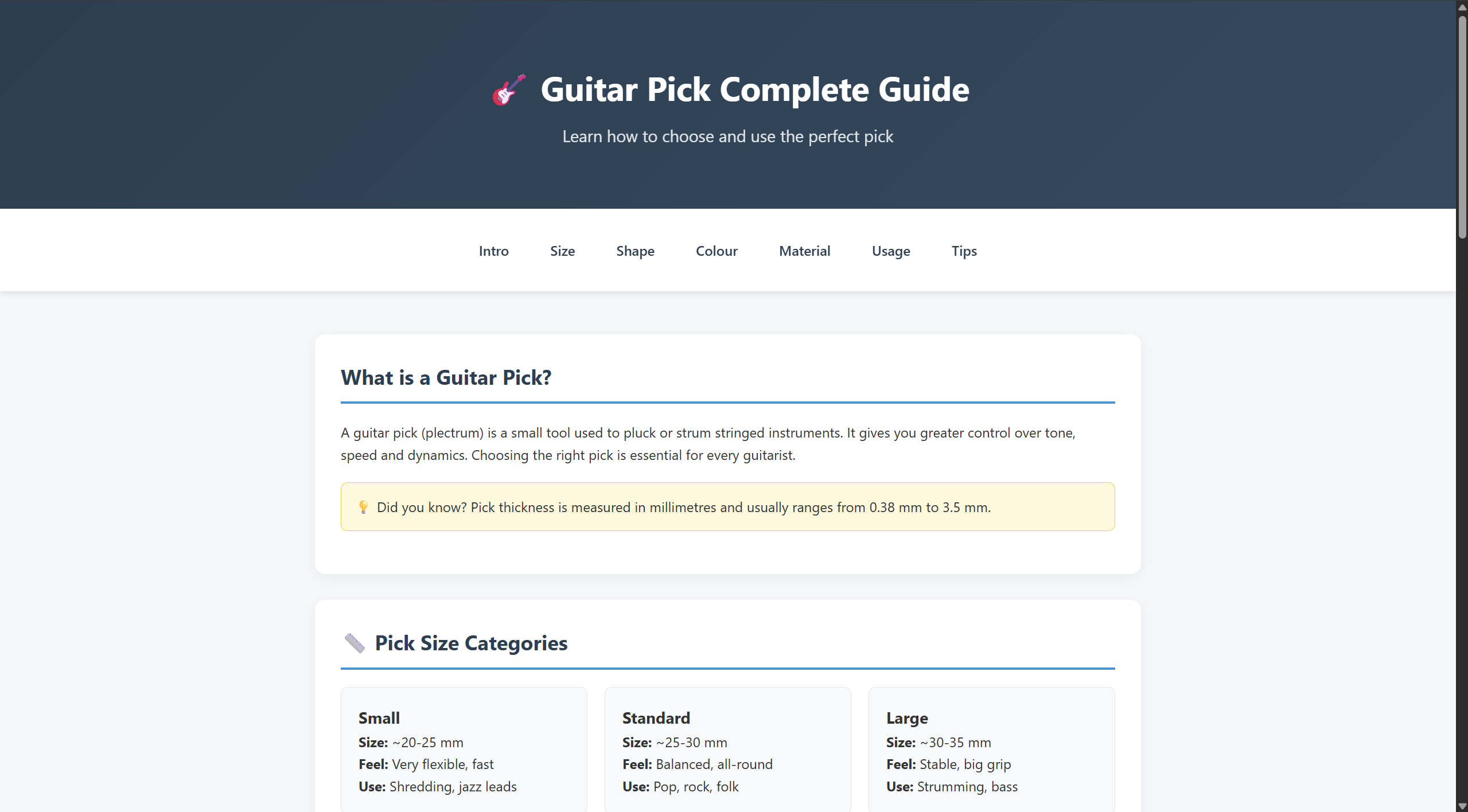
The web introduces difference guitar pick, including(but not limited to): colour, size, shape. And how to use guitar pick correctly.
by Xiaohua Sun• xiaohua.sun.24@stu.hainan-biuh.edu.cn
Description
Below is a concise yet complete “extended” guide that folds all the new information from the returned sources into your original sentence pattern. (Where a detail comes from the search results, the citation [^n^] is placed at the end of the sentence.) The web introduces many differences among guitar picks, including (but not limited to): Colour – mainly visual, but coloured dips or rubberised dots are often added to create extra grip so the pick does not spin or drop mid-song . Size – the overall footprint ranges from the tiny “jazz” profile to the larger triangular “gypsy” shape; a bigger pick gives more contact surface for your fingers, while a smaller one frees up the picking hand for rapid single-note lines . Shape – three broad families exist: Standard (equilateral-style triangle with rounded shoulders), Triangle (three usable, blade-like corners for double-stops or rapid corner swapping), Teardrop (narrow body that tapers to a soft or sharp tip) . Tip geometry – a round tip delivers a softer attack and warmer, bass-heavier tone ideal for strumming, whereas a sharp tip increases treble, volume and note-to-note definition for solos . Thickness – measured in millimetres and grouped as Light (< 0.60 mm), Medium (0.60-0.80 mm) or Heavy (> 0.80 mm); thinner picks flex more, emphasising treble and reducing bass, while thicker picks add volume, mid-range punch and precise attack . Hardness & material – cellulosic, nylon, Delrin®, Tortex®, metal, stone, etc. A harder medium-gauge pick can sound almost as fat as a heavy pick without the bulk, whereas a soft thick pick (e.g., felt ukulele picks) produces a darker, almost brushed tone . Texture/grip – glossy surfaces feel smooth and classic, but high-grip matte, raised logos or powdered rubber coatings prevent slippage during long gigs . How to use a guitar pick correctly (universal basics) Hold – pinch the pick between the side of your index fingertip and the pad of your thumb so that roughly 5–7 mm protrudes. Do not bury the pick deep inside the palm; the wrist must stay relaxed. Angle – for everyday strumming, tilt the pick 10-20° to the string so it “slices” rather than plows; for fast alternate-picking, keep the angle minimal and let the tip do the work. Motion axis – strum from the wrist/elbow; single-note lines from the wrist; avoid locking the elbow or finger-joint muscles. Depth – barely let the tip escape the opposite side of the string; the thicker the pick, the less depth you need. Dynamics – lighter gauges force you to dig in for volume, teaching control; heavier gauges reward minimal effort—start medium (0.73 mm) and experiment. Maintenance – rotate the pick if the tip frays; a smooth, symmetrical bevel keeps tone consistent. Safety – if a pick slips into the sound-hole (acoustic), shake it out immediately; never leave foreign objects inside a guitar body. Mastering these variables—colour for grip, shape for ergonomics, thickness/hardness for tone, and correct physical technique—lets you turn the humble plectrum into a precision tone tool rather than an afterthought.
Desktop Homepage
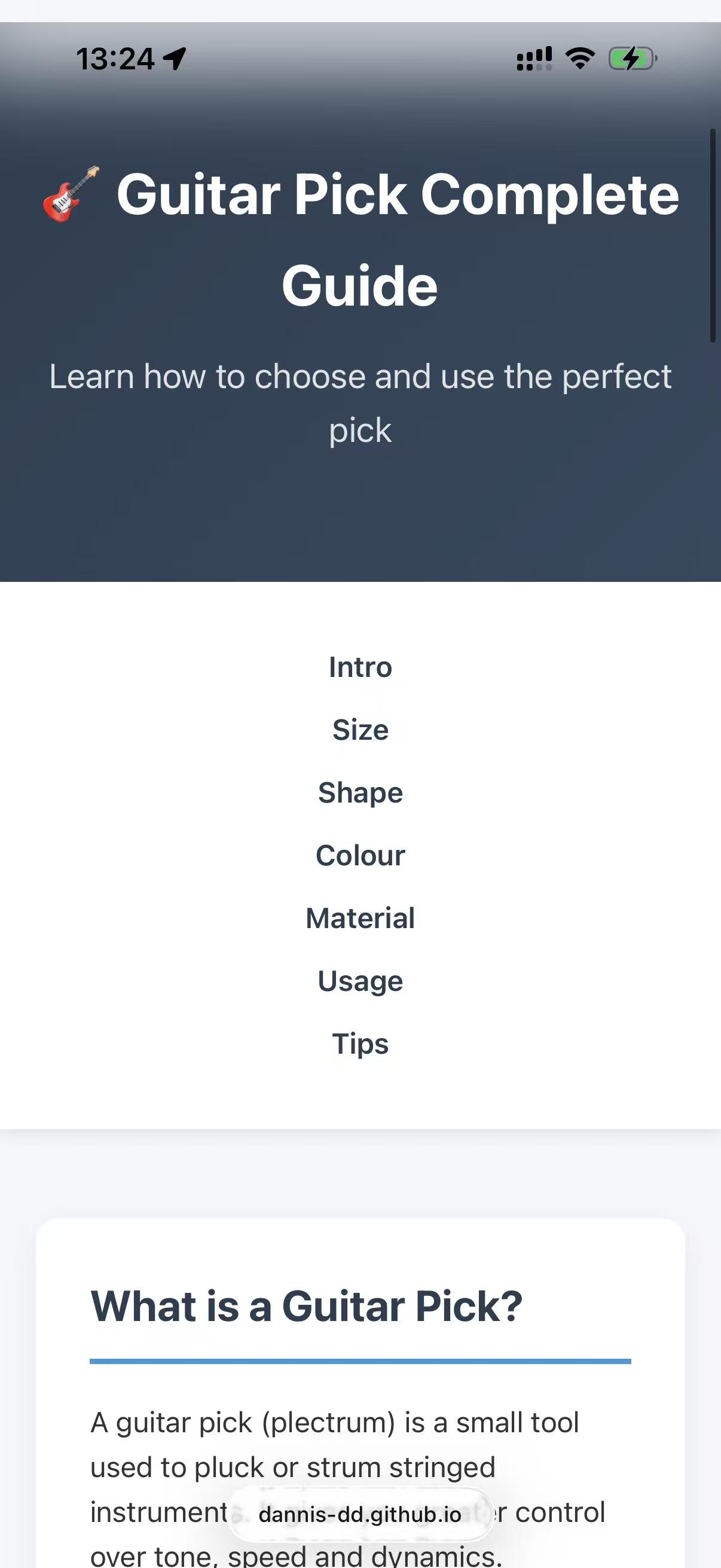
Mobile Homepage
Open Graph Image
Favicon